top of page
< Back

Dishwasher - ONET Occupation Study

$50/h

United States

Catalogue update: this role is no longer listed in the current Mercor catalogue. Browse current AI Training opportunities.

About the role

Participate in occupational research about the everyday work of dishwashers. The study informs descriptions of real tasks and workplace requirements.

Skills and focus areas

Dishwashing · Kitchen Cleaning · Kitchen Equipment · Kitchen Workflow

What you will do

  • Complete an online survey or interview about kitchen routines, equipment and responsibilities.

Experience and requirements

  • At least two years specifically working as a dishwasher.
  • Current experience or experience within the previous twelve months.
  • US residence; cooking, service and management roles do not qualify on their own.

Working arrangements

  • The initial study takes approximately 30–75 minutes.
  • Any optional follow-up is paid separately.

Similar jobs

Explore related opportunities on Sporterer.

Expert Interviewer
Research & Surveys · $50–$60/h
United States

Medicare Advantage Brokers Survey – Agent & Enrollment Insights
Research & Surveys · $140 one-time
United States

Market research / competitive intelligence Evaluator
Research & Surveys · $80–$120/h
Global

You’ll be redirected to our partner’s application page

AI TRAINING OPPORTUNITY

bottom of page
Sporterer
OPEN OPPORTUNITIES

AI Training Opportunities

Loading opportunities…

Sporterer
Future of work · September 2026

How big is the remote / hybrid opportunity?

Remote work is already huge — but the bigger story may be the hundreds of millions of jobs that could still move beyond geography.

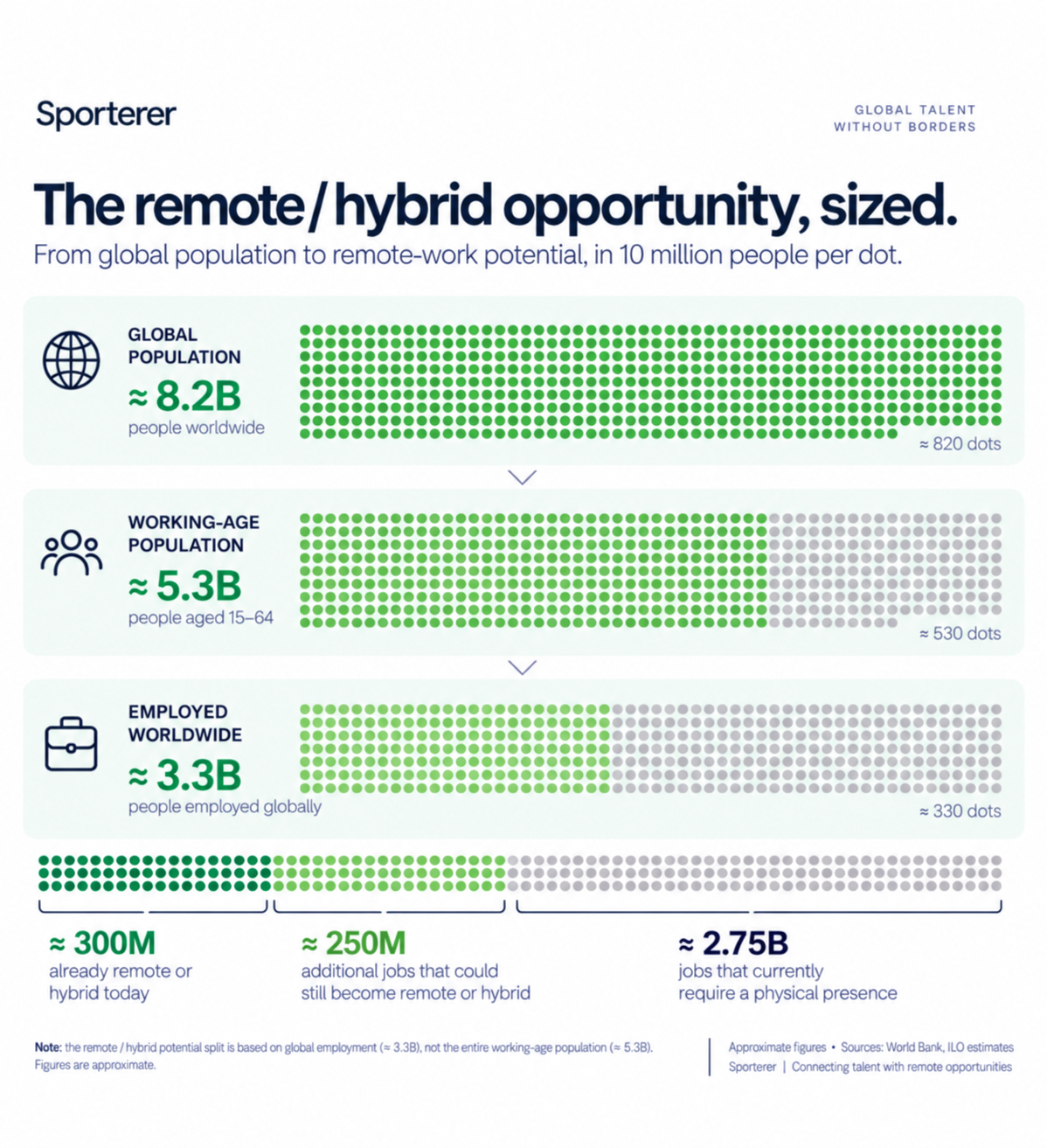
Global remote and hybrid work opportunity infographic

Remote work already connects millions of people with companies they would never have been able to work for a decade ago. But compared with the size of the global labour market, it may still be early.

The interesting number is not only how many people work remotely today — it is how many roles could plausibly become remote or hybrid next.

The chart above starts with roughly 3.3 billion people employed worldwide. Around 300 million jobs are already remote or hybrid, while an additional pool of roughly 250 million roles could potentially move in that direction as technology, workflows and company culture continue to change.

Skills are becoming more portable

This matters because more work can increasingly be matched to expertise rather than location. AI training and evaluation are a good example: companies need lawyers, engineers, designers, editors, researchers, finance professionals and many other specialists to help improve AI systems.

For workers, that creates access to projects outside their local market. For companies, it expands the talent pool from one city or country to the world.

Explore remote opportunities →