top of page
< Back

Principal Research Scientist (Computer Science / Computational Physics)

$100–$400/h

Remote

Role overview

Role Title: Principal Research Scientist (Computer Science / Computational Physics)


Role Type: Contractor (flexible, Part-Time or Full-Time)


Location: Remote


micro1 is engaging Principal Research Scientist (Computer Science / Computational Physics)s to contribute to an advanced customer project at the intersection of computational theory and AI. In this role, you'll apply your expertise to help train next-generation AI systems. Your work will shape how models learn, reason, and perform through high-quality, real-world input. No prior experience in AI is required — your domain knowledge is what matters. You will work with frontier AI models and agents to tackle open problems, drive research direction, and define standards for scientific breakthroughs. Your insights and rigorous approach will be pivotal in charting what counts as genuine progress within your subfield.


Scope of Work

  1. Identify, frame, and articulate foundational open problems, theoretical bounds, or simulation challenges where verifiable progress can be demonstrated.
  2. Guide AI models and agents in multi-step research processes—ranging from proofs and algorithms to numerical experiments and high-performance simulations.
  3. Critically assess and validate results, utilizing proof checks, computational reproduction, and formal methods to pinpoint the limits of model-generated reasoning.
  4. Evaluate and document the novelty, correctness, and significance of research outputs relative to current literature and established results.
  5. Produce clear, concise research memos detailing research attempts, partial solutions, and observed model limitations or failure patterns.
  6. Advise on research directions, recommending promising subfields and open problems suitable for advancement via AI models and computational tools.


Preferred Qualifications

  1. 7 - 10+ years of active research in computer science or mathematical/computational physics, with a strong record of scholarly contributions.
  2. Recognition at the field level—such as major prizes, society fellowships, or plenary/invited talks at top scholarly events.
  3. A consistent publication record in leading venues within your domain, with recent results published in the past year.
  4. Demonstrated success resolving named open problems or introducing influential concepts adopted by peers.
  5. Deep, hands-on experience with computational research methods: simulation, numerical analysis, algorithmic implementation, and/or high-performance computing environments.
  6. Proven ability to rigorously examine technical work outside your immediate area of expertise.
  7. Experience on program committees, editorial boards, or with formal research tools (e.g., Lean, Coq, SAT/SMT solvers) is a strong plus, as is a public record of outlining open problems or showcasing research with advanced AI systems.

Similar jobs

AI Safety Experts — English & Assamese · Mercor · $16–$22/h · Remote

Agriculture, Forestry & Environmental Experts · Micro1 · $40–$60/h · Remote

Analytical Chemist · Mercor · $65–$75/task · Remote

You’ll be redirected to our partner’s application page

AI TRAINING OPPORTUNITY

bottom of page
Sporterer
OPEN OPPORTUNITIES

AI Training Opportunities

Loading opportunities…

Sporterer
Future of work · September 2026

How big is the remote / hybrid opportunity?

Remote work is already huge — but the bigger story may be the hundreds of millions of jobs that could still move beyond geography.

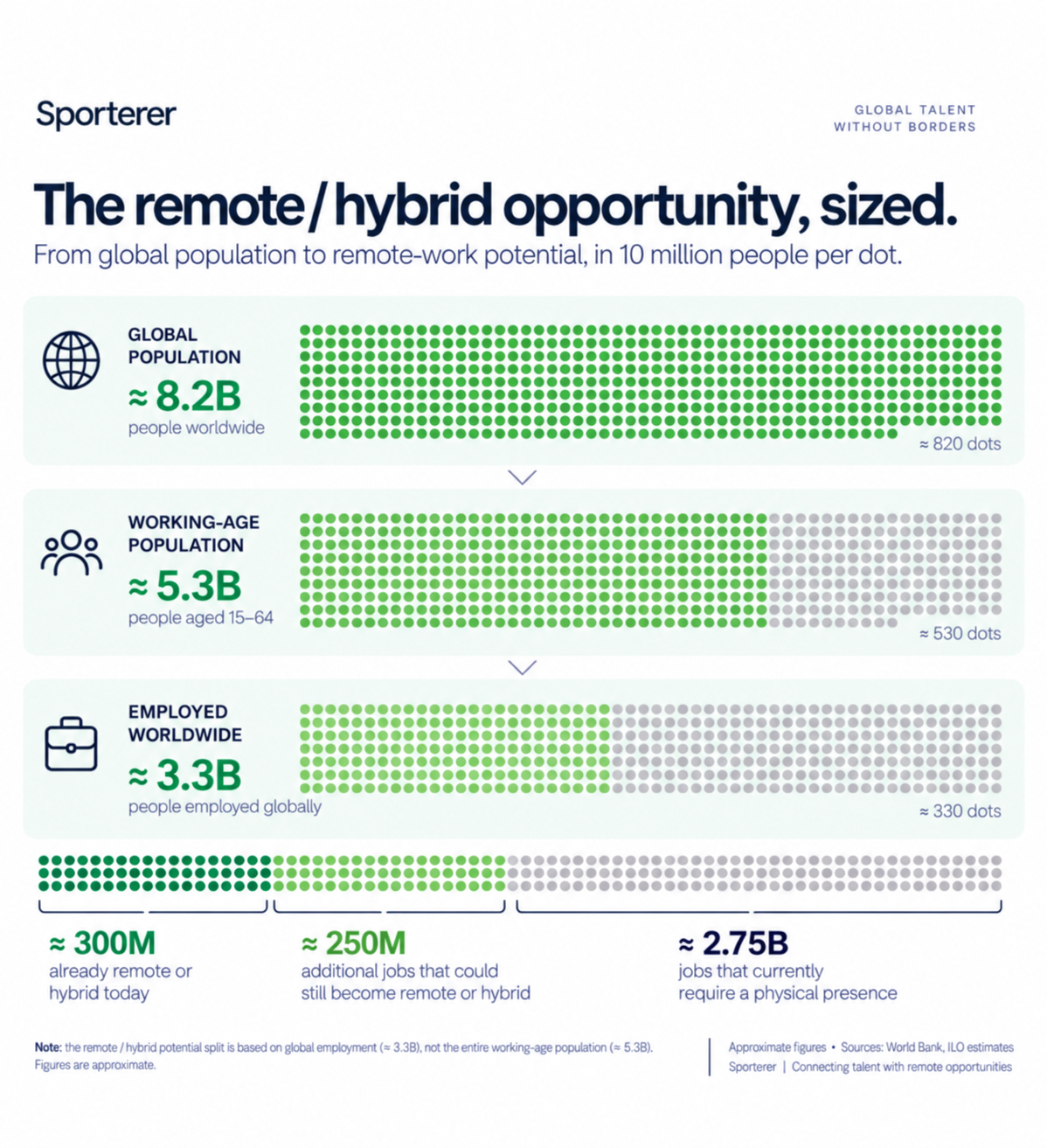
Global remote and hybrid work opportunity infographic

Remote work already connects millions of people with companies they would never have been able to work for a decade ago. But compared with the size of the global labour market, it may still be early.

The interesting number is not only how many people work remotely today — it is how many roles could plausibly become remote or hybrid next.

The chart above starts with roughly 3.3 billion people employed worldwide. Around 300 million jobs are already remote or hybrid, while an additional pool of roughly 250 million roles could potentially move in that direction as technology, workflows and company culture continue to change.

Skills are becoming more portable

This matters because more work can increasingly be matched to expertise rather than location. AI training and evaluation are a good example: companies need lawyers, engineers, designers, editors, researchers, finance professionals and many other specialists to help improve AI systems.

For workers, that creates access to projects outside their local market. For companies, it expands the talent pool from one city or country to the world.

Explore remote opportunities →