top of page
< Back

Medical Coder (CCS / CIC)

$50–$70/h

US - Remote

Role overview

Role Title: Medical Coder (CS / CIC)


Role Type: Contractor


Location: US - Remote


micro1 is engaging Medical Coders (CCS / CIC certified) to contribute their expertise to a dynamic project for a valued customer. In this role, you'll apply your expertise to help train next-generation AI systems. Your work will shape how models learn, reason, and perform through high-quality, real-world input. No prior experience in AI is required — your domain knowledge is what matters.


Scope of Work

  1. Annotate and review inpatient medical records, including admission notes, progress notes, operative reports, consults, lab and imaging results, and discharge summaries, ensuring precise ICD-10-CM and ICD-10-PCS code assignment based on documentation.
  2. Identify principal and secondary diagnoses, sequence codes according to guidelines, assign Present on Admission (POA) indicators, and validate MS-DRG assignment, including the identification of CCs and MCCs, to verify and enrich data sets.
  3. Apply inpatient-specific coding conventions, such as UHDDS definitions, ICD-10-CM/PCS Official Guidelines for Coding and Reporting, and AHA Coding Clinic guidance, while identifying hospital-acquired conditions (HACs) and patient safety indicators.
  4. Collaborate with project stakeholders using both written and verbal communication to clarify requirements, resolve documentation ambiguities, and ensure data integrity.
  5. Deliver high-quality feedback on coding guidelines and complex cases to support project workflow improvements and enhance AI model understanding.
  6. Ensure accuracy and completeness of all coding-related annotations per current best practices and coding standards.


Preferred Qualifications

  1. Active AHIMA Certified Coding Specialist (CCS) or AAPC Certified Inpatient Coder (CIC) credential.
  2. Thorough expertise in ICD-10-CM, ICD-10-PCS, and MS-DRG methodology with hands-on inpatient coding experience.
  3. Experience coding in diverse inpatient settings, such as acute care, teaching hospitals, specialty units, surgical, trauma, oncology, cardiology, and transplant cases.
  4. Proficiency in reviewing and coding various types of clinical documentation and addressing complex coding challenges.
  5. Strong written and verbal communication skills, demonstrating meticulous attention to detail and clarity.
  6. Access to current ICD-10-CM and ICD-10-PCS code sets, Official Coding Guidelines, and MS-DRG grouper tools.

Similar jobs

Adolescent Suicide & Self-Harm Specialist · Micro1 · $45–$95/h · Remote

Adolescent/Child Safeguarding & Exploitation Specialist · Micro1 · $45–$95/h · Remote

Cardiologist – Clinical Consultant (ATTR Cardiac Amyloidosis) · Mercor · $120–$150/h · United States

You’ll be redirected to our partner’s application page

AI TRAINING OPPORTUNITY

bottom of page
Sporterer
OPEN OPPORTUNITIES

AI Training Opportunities

Loading opportunities…

Sporterer
Future of work · September 2026

How big is the remote / hybrid opportunity?

Remote work is already huge — but the bigger story may be the hundreds of millions of jobs that could still move beyond geography.

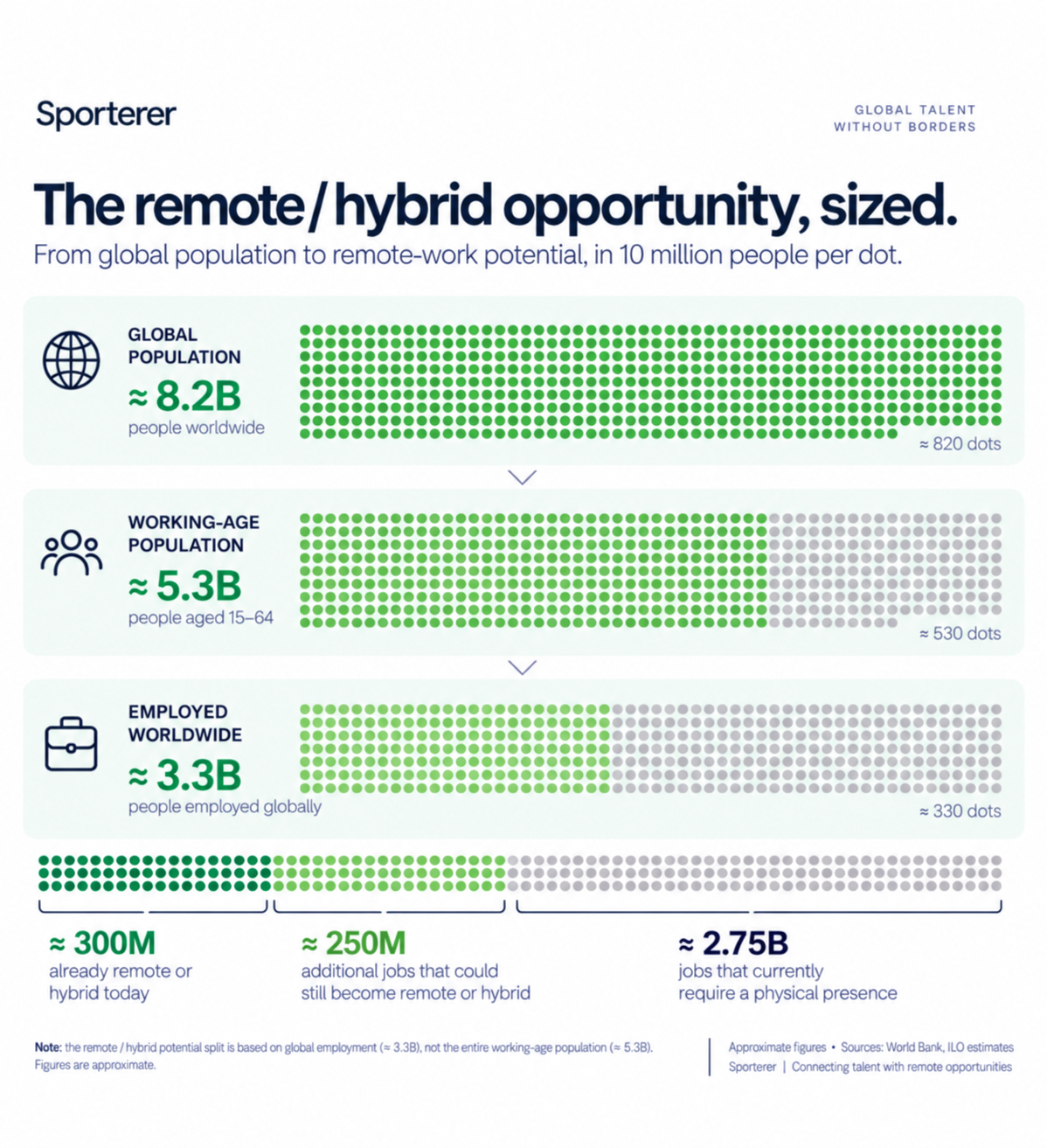
Global remote and hybrid work opportunity infographic

Remote work already connects millions of people with companies they would never have been able to work for a decade ago. But compared with the size of the global labour market, it may still be early.

The interesting number is not only how many people work remotely today — it is how many roles could plausibly become remote or hybrid next.

The chart above starts with roughly 3.3 billion people employed worldwide. Around 300 million jobs are already remote or hybrid, while an additional pool of roughly 250 million roles could potentially move in that direction as technology, workflows and company culture continue to change.

Skills are becoming more portable

This matters because more work can increasingly be matched to expertise rather than location. AI training and evaluation are a good example: companies need lawyers, engineers, designers, editors, researchers, finance professionals and many other specialists to help improve AI systems.

For workers, that creates access to projects outside their local market. For companies, it expands the talent pool from one city or country to the world.

Explore remote opportunities →